PodcastIQ
An AI platform that makes podcast audio searchable, analyzable, and verifiable — semantic search across 290+ episodes powered by a 9-agent LangGraph system, a Neo4j knowledge graph, and Snowflake Cortex.

- 25
- Channels
- 286
- Episodes
- 44
- Months covered
- 13,807
- Chunks
- 768
- Vector dimensions
- 100%
- Embedded
See it run
Recorded trace, then the videoEight queries, one per intent. Each replays the real execution trace: guardrails, routing, agent steps and measured timings.
Pick a query
> What did experts say about AGI?
Full walkthrough
The problem
Audio is not queryableCannot Search
100 episodes = 100 hours of listening
Cannot Track change
No record of a revised prediction
Cannot Attribute
No link from a claim to a speaker
Three phases
11 stages- 01
Ingest
Data engineering
- In
- YouTube captions
- Out
- Queryable chunk table
5 stages
- 02
Enrich
AI engineering
- In
- Raw chunks
- Out
- Attributed, linked claims
4 stages
- 03
Serve
Agent runtime
- In
- A user question
- Out
- Guarded, cited answer
2 stages
Stage by stage
Decisions, not descriptionsData engineering
YouTube captionsQueryable chunk table
AI engineering
Raw chunksAttributed, linked claims
Agent runtime
A user questionGuarded, cited answer
Arrow keys to step
Extraction
yt-dlp + YouTube Data API v3
- 25 channels, 6 genres
- Filter: 30 min or longer, post-2022
- WebVTT captions plus metadata
- Resumable via checkpoint JSON
Decision
- Chose
- Captions
- Over
- Audio download plus Whisper
Because
- No GPU
- No transcription cost
- Timestamps come free
Cost
Inherits YouTube caption errors. Rules out acoustic diarization.
- 286
- episodes
- 146 MB
- JSON
- 0
- failures
Agent runtime
1 router, 8 specialistsClassifies into one of eight intents, then dispatches. Unrecognised output falls back to SEARCH.
- SEARCH1.5s
Search
no LLM
Vector retrieval over Cortex Search.
“What did Sam Altman say about GPT-5?”
chained pair
- SUMMARIZE3.5s
Summarization
llama3.1-70b
Synthesises retrieved chunks, cited back to timestamps.
“Best strategies for building a startup?”
chained pair
- GRAPH4.5s
Knowledge graph
70b + Cypher
Generates Cypher, traverses Neo4j, retries on malformed output.
“Who has Sam Altman appeared with?”
- TEMPORAL3.8s
Temporal
SQL + 70b
Reads pre-computed drift pairs.
“How has AGI opinion changed over time?”
- FACTCHECK2.5-5.5s
Fact-check
Cortex + Brave
Cortex pre-filter first; only uncertain claims reach the web.
“Fact check: GPT-5 released in 2024”
- COMPARE4.0s
Comparison
2 SQL + 70b
Pulls each side independently, then contrasts.
“Compare Lex Fridman vs Joe Rogan on AI safety”
- RECOMMEND2.0s
Recommendation
SQL + 70b
Falls back through looser filters so narrow asks still return.
“Suggest episodes about AI”
- INSIGHT4.2s
Insight
5 SQL + 70b
Aggregates across the corpus to answer questions about the corpus.
“Which channel has the most contradicted claims?”
Architecture
Full system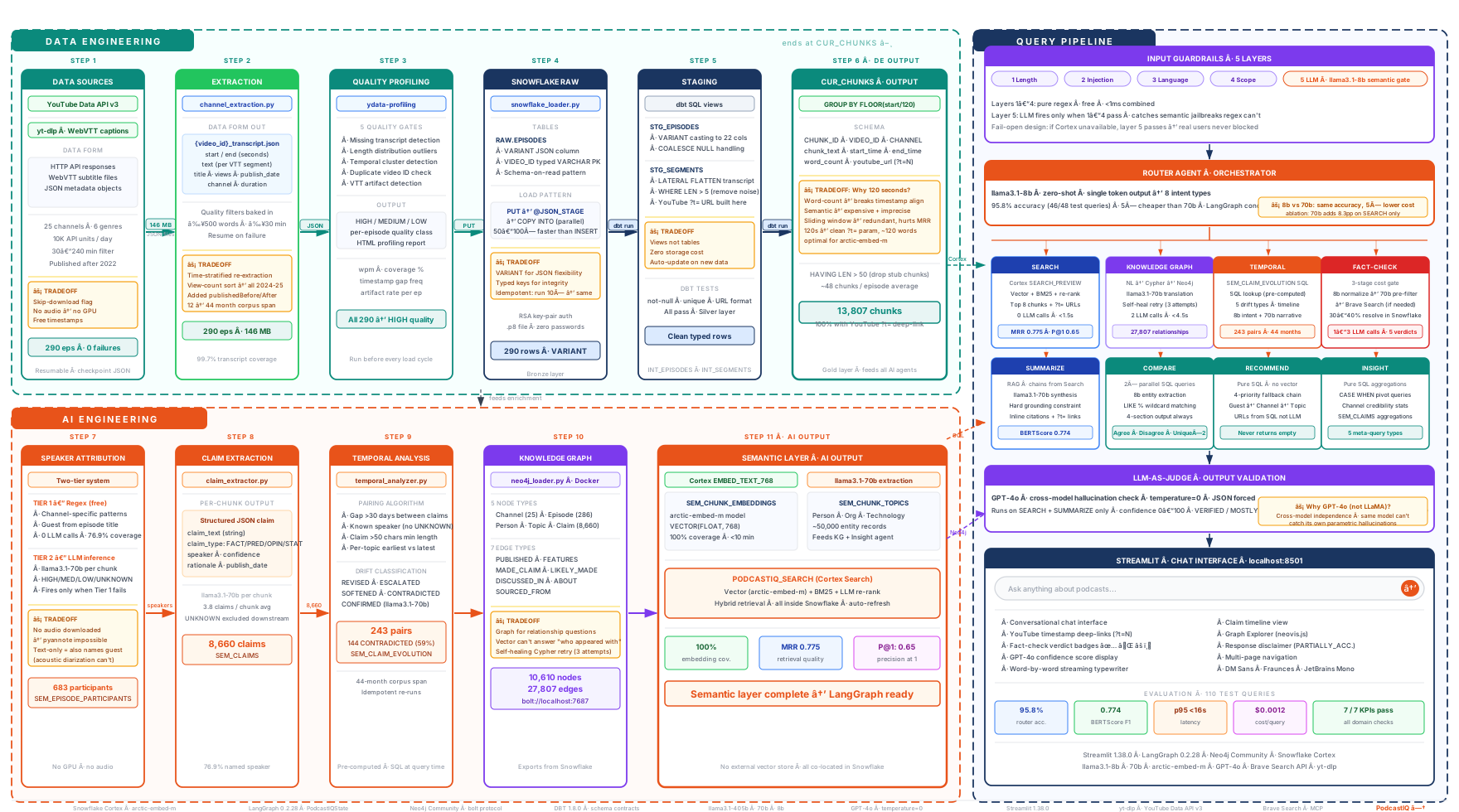
Scroll to follow the flow
Cost per query
$1.19 per 1,000Search and Graph are effectively free: both retrieve without a generation step. Summarize costs the most because it passes 5 to 8 retrieved chunks into the prompt.
Stack
Everything usedWarehouse and modelling
- Snowflake
- dbt
- SQL
- Snowflake Cortex
Graph
- Neo4j
- Cypher
- Docker
Models
- llama3.1-70b
- llama3.1-8b
- arctic-embed-m
- GPT-4o
AI orchestration
- LangGraph
- Cortex Search
- GraphRAG
- Brave Search API
Ingestion
- Python
- yt-dlp
- YouTube Data API v3
- ydata-profiling
Interface
- Streamlit