IMDb Analytics Pipeline
A production-style data engineering pipeline that ingests, profiles, cleans, and models ~190 million IMDb records into a Snowflake warehouse powering self-service Power BI and Tableau dashboards.

- 190M
- Total rows
- 7
- Source datasets
- 91M
- Largest table
- 51M
- Alternate titles
- 2-layer
- Snowflake warehouse
- 2025
- Delivered
The problem
Scale breaks naive loadsVolume
190M rows across 7 datasets, one of them 91M on its own
Dirty by design
IMDb encodes missing values as a literal string, and packs multiple values into single fields
Query shape
Analysts ask by year and genre, which a raw load cannot answer without scanning everything
The corpus
7 datasets, 190M rows| Dataset | Share | Rows | Role |
|---|---|---|---|
| title.principals | 90,984,000 | Cast and crew per titlemany-to-many bridge | |
| title.akas | 51,409,000 | Alternate titles by regionlocalisation | |
| name.basics | 14,195,000 | People master datapeople dimension | |
| title.basics | 11,464,000 | Core title metadatatitle dimension | |
| title.crew | 11,464,000 | Directors and writerscreative ownership | |
| title.episode | 8,815,000 | Episode to series linksTV hierarchy | |
| title.ratings | 1,536,000 | Ratings and vote countsthe measures |
One dataset carries 48% of the corpus. title.principals is the many-to-many bridge between titles and people, which is why it is both the largest table and the one whose join strategy decides warehouse performance.
Six stages
Decisions, not descriptionsArrow keys to step
Ingest
Azure Data Factory → Data Lake Gen2
- 7 IMDb .tsv.gz datasets pulled to a raw zone
- Landed unmodified in Azure Data Lake Gen2
- ADF pipelines schedule and monitor the pulls
- Compression kept until load
Decision
- Chose
- Land raw, transform later
- Over
- Transform in flight on ingest
Because
- A reload never needs to re-download ~190M rows
- Raw files are the audit trail when a number is questioned
- Cleaning belongs in a dedicated stage, not the fetch
Cost
Two copies of the data: raw and modelled.
- 7
- datasets
- 190M
- rows landed
Architecture
ADF to Power BI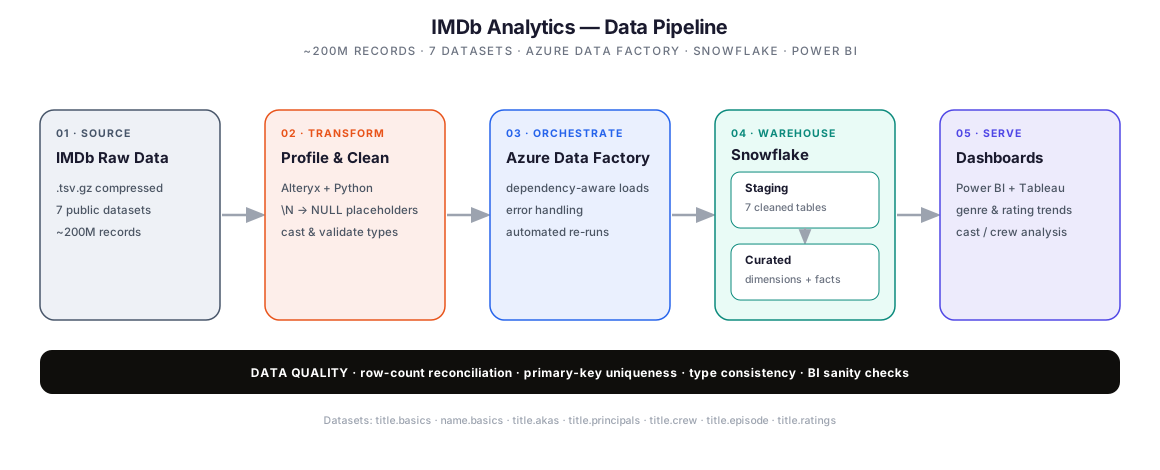
Tuning & trust
Where the warehouse is wonCOPY INTO
Data Lake stage → Snowflake staging
Parallel bulk load across the warehouse. Row-by-row INSERT at ~190M rows is orders of magnitude slower and far heavier on the warehouse.
Clustering
title.principals (91M rows)
Clustering the cast/crew bridge on its join key prunes micro-partitions, so the largest join scans a fraction of the table rather than all 91M rows.
Staging / curated split
two-layer Snowflake
Cleaning runs once into staging; BI reads the modelled curated layer, so heavy transforms never re-run inside a dashboard query.
Reconciliation
every pipeline layer
Row-count reconciliation and primary-key uniqueness checks across layers are what let the dashboards be trusted at all.
A star schema is the easy half. On Snowflake the win is in how the 91M-row cast/crew bridge is loaded and clustered, and in the reconciliation checks that prove the modelled layer still matches the raw load — the first things worth asking about in a warehouse review.
Stack
Everything usedStorage & ingest
- Azure Data Factory
- Azure Data Lake Gen2
Profiling & cleaning
- Alteryx
- Python
Warehouse
- Snowflake
- Two-layer
- COPY INTO
- Clustering keys
Modelling
- ER Studio
- Star schema
- Conformed dimensions
- Bridge tables
Serving
- Power BI
- Tableau
Quality
- Row-count reconciliation
- PK-uniqueness checks